
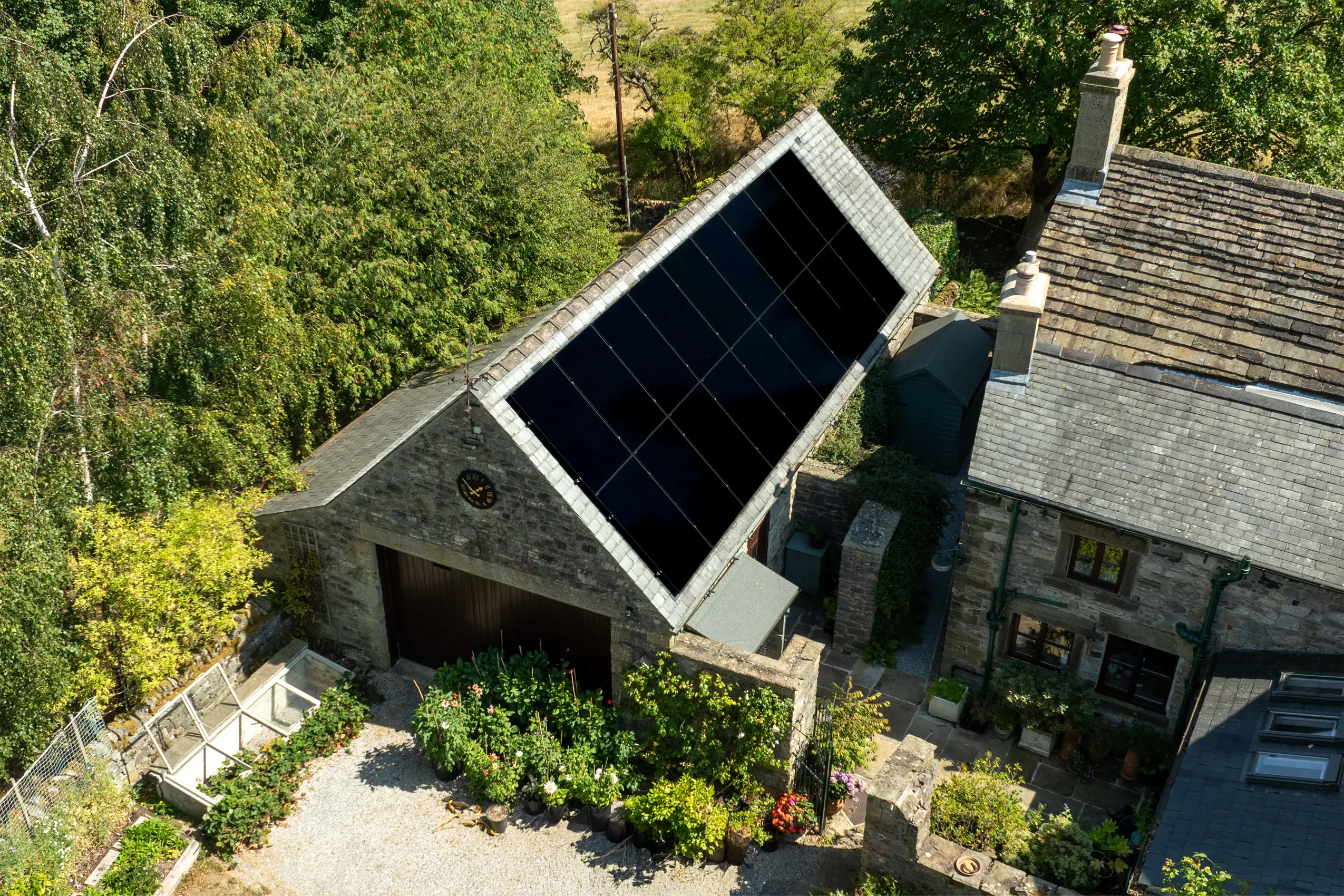
Believe it or not it is possible to get solar panels for listed properties in the Peak District National Park, as Simon Daniell explains.
After three years trying, we have both planning and listed building permission from the Peak District National Park Authority (PDNPA) for solar panels, air source heat pumps (ASHP) and some secondary glazing for our grade 2 listed property.
You ask what is the secret to success? Well, it’s persistence and not giving up but here are some tips and I’m very happy to discuss these.
One needs to know the regulations, whether the building is in a conservation area and the advice from Historic England. One must be prepared to go all the way to appeal with the government planning inspector. One must get all the support you can, and we had 47 letters of support for which we are most grateful.
One needs to be prepared for a site visit by the planning committee when one is not allowed to speak to the committee who may not even introduce themselves. One needs to be prepared to register to speak at the planning committee meeting, but you and any supporters will only have 3 minutes, and you may find that you are not allowed to speak to the officer’s report that has been supplied to the meeting.
The pre-planning application process has been reopened and is helpful. Listed buildings will need a heritage statement which will probably involve trips to the Derbyshire records office at Matlock and the Chatsworth Archives. The crux is policy CC2 so that the benefit outweighs the negative. [Policy CC2 is the PDNPA policy, which is the core planning policy for Low Carbon and Renewable Energy Development in the park.]
For solar the PDNPA’s guidance states that the whole roof should be covered, but in our case the committee decided that they required less than the whole roof to be covered.
Panels should be hidden from view from public roads and rights of way. But look for similar examples to your proposal. Panels should be all black and non-reflective. However, in Monyash and Over Haddon many sets of panels can be seen facing the main road.
If your building is not listed and not in a conservation area you may just be able to install solar as a permitted development.
If one is installing solar panels the most cost-effective solution is to use all the electricity oneself. Therefore, this needs the installation of accompanying batteries especially if installing ASHPs as allows one to store off-peak electricity for off-peak use. Some suppliers will offer enhanced rates for peak hours export (4pm-7pm) and even control your batteries to give you good export fees whilst supporting the National Electricity Grid to save switching on gas fired powered generation.
ASHPs may be more acceptable to the planners if the exterior units are coloured to blend in with their position and screened by planting. How the units are mounted and how the pipes enter the building and connect to existing pipework will also need to be specified. Like all ASHP installation the quality of the design is paramount.
Therefore, one needs an experienced installer who will accurately perform heat loss calculations and tailor the system to the building and the way it is used. It is of course sensible to insulate and draught proof as much as possible and aim to run the ASHP at the lowest possible flow temperature as their efficiency decreases as the flow temperature increases. Wet underfloor heating works well with ASHPs but for more compact buildings air-to-air heat pumps may be more appropriate than air-to-water.
Any building can have an ASHP and one can find out by turning the boiler flow temperature to 45°C and seeing if the building is warm enough. But remember that unlike the pulsed fossil fuel heating an ASHP works best continuously so in trying this one may need to add a couple of hours to the boiler timer. This will also allow an assessment of radiators in rooms as it isn’t necessary to upgrade most radiators.
Secondary glazing is possible where double glazing is not and thankfully, we have a local firm that specialises in listed buildings e.g. Port Sunlight, churches, national libraries, etc.
Parish councils will be consulted so attend the meeting when your proposal is discussed and speak to it.
I certainly don’t have all the answers but I’m happy to help in any way I can. We also have many local climate actions and community energy groups who are happy to support the process.
Other than all the climate change mitigation points you may want to note the following if relevant:
- There is a climate crisis, and the Peak District’s electricity infrastructure is inadequate to import the power needed, making it necessary to generate as much power at the point of use as possible and this also reduces losses in electricity transmission and distribution.
- The application is in tune with the Government’s latest Warm Homes Plan initiative announced on 20 January 2026.
- The solar panels are not on, the historic building.
- The solar panels are not visible from the public road or byway
- The panels are all black on a dark grey slate roof.
- The installation will be removed when the system falls out of use and any restoration needed will be complete.
- The Grade II listing affects everything within the curtilage and ground mounted arrays have been considered in relation to the setting.
- The buildings date from nnnn and are built with solid traditional limestone and rubble filled walls. They are damp and need to be conserved for future generations.
- There are oil-fired boilers which ASHPs will replace for heating.
- Secondary double glazing on the historic windows will reduce heat loss and draughts.
- Planning decisions are influenced by any and all comments received so obtain as much support as possible for your application.
Other Points of relevance:
- The proposal is in line with the Peak District National Park’s observations on climate change and how individuals can play their part in tackling it in ways which motivate lifelong behaviour change.
- The proposal reflects the plans outlined in the authority’s Climate Change Action Plan 2009–2011, Carbon Management Plan 2020-2050 and Local Development Framework documents and included in the Local Plan to 2043 consultation. All of these support the decarbonising agenda moving away from fossil fuels to renewable energy.
- The NPPF in paragraph 11 expects Local Planning Authorities to adopt proactive strategies to mitigate and adapt to climate change.
- Paragraph 162-168 of the NPPF states that tackling climate change is central to the economic, social, and environmental dimensions of sustainable development in line with the Climate Change Act 2008 and Section 19 of the 2004 Planning and Compulsory Purchase Act.
- There is also a highly significant section of the NPPF (2019 revisions, section 2) which states that ‘The purpose of the planning system is to contribute to the achievement of sustainable development.’
- The proposal assists by reducing carbon (and other) emissions (indirect and direct) from the production and use of electricity and by demonstrating the authority’s determination and proactive support for their stated aims towards a net zero target and in enabling a heritage asset to display a non-damaging green technology.
- The PDNP Supplementary Planning Document (SPD) and the 2024 appeal both treat garage roofs as the low-impact option for historic properties.
- A ground-mounted array in the garden introduces a new, visible feature in the open setting which is potentially more harmful to landscape character, the historic house’s setting, and any Conservation Area views.
Other relevant comments:
From an application for solar panels on another listed building but in the Derbyshire Dales District Council area:
“The public benefits of the proposal would be in reduction in carbon equivalent emissions from heating the building, probably by over half, and also in the example set of a successful installation which could encourage others to follow. As members of the public, in our view these advantages outweigh building conservation disadvantages, which can be mitigated by providing some form of explanation of both the heritage and rationale for PV panels. We are far more pleased at the initiative of the owners in seeking to reduce the carbon footprint of heating their traditional building, famously difficult locally with our legacy of stone housebuilding, with reasonable efforts to make this inconspicuous, than we are troubled by the small compromise on its physical look. We hope PV panels will shortly be a familiar and widespread successful contribution to Derbyshire Dales District Council and Matlock Town Council planning and policy efforts to reduce our collective carbon footprint here.”
Examples of listed buildings with solar:
- Aldern House (Grade 2 listed) (NP/DDD/1015/0933) – 15 panels on adjacent building. Approved – as the Authority has a statutory duty to have special regard to the desirability of preserving the Grade II listed Aldern House and its setting and any features of special architectural or historic interest which it possesses.
- Wormhill Chapelsteads Farm (Grade 2 listed) (NP/HPK/0922/1194) – In-roof panels on modern garage. Refused but approved on appeal to planning inspector.
- Cressbrook Cressbrook Hall – Ground-mounted array. Allowed by planning inspector despite initial National Park refusal.
- Chelmorton The Old Vicarage – (NP/DDD/0622/0830) – Installation of a 20 solar panel array at the rear. Officers recommended refusal, approved by committee.
- Monyash The Old Smithy Tearooms – (NP/DDD/0923/1022) Installation of 12 solar panels on the pitched roof/front elevation and 6 on the flat roof to the rear. Officers recommended refusal, the committee approved.
- Monyash – 3 other applications – 2 refused, 1 withdrawn but there are several houses on the main road with panels.
- Litton Swallow Croft Barn – (NP/DDD/1224/1328) – In-roof mounted solar PV panels on the principal south elevation. Officers strongly recommended refusal, the committee approved the application.
- Croft House, Main Street – (NP/DDD/0807/0755) – Installation of solar panels. Refused at officer/delegated level, no committee.
- Taddington Ade House – (NP/DDD/0624/0590) – Additional roof mounted solar. Officers recommended refusal, committee deferred for further discussion.
Committee minutes show members often prioritise climate benefits when harms are deemed acceptable or mitigable. The trend seems to be officer refusal overturned in many cases by the Committee.
For more information contact Simon Daniell by email